Sunday, April 13, 2014
The verdict is in...
1. Fruitvale Station- possibly one of the most important films ever made, not an over-dramatized version of a real family's life and loss, investigates racial stereotypes, power politics, and gender expectations
2. Moonrise Kingdom- genius, hilarious, organized and stylized cinematography with winks at Art History
3. Wendy and Lucy- beautiful performance by Michelle Williams (and of course Lucy), investigates wealth disparities which is especially relevant now
4. My Own Private Idaho- interesting cinematography, loved the frozen sex scenes, the relatable qualities of the characters, and the juxtaposition of "high" and "low" cultures
5. Killer of Sheep- realism at its best, important statement about gender and race
6. Frances Ha- chronicle of the millennial struggle, the role was made for Greta Gerwig, both uplifting and heartbreaking, I'm pretty sure I remember this movie in full color, even though it is definitely in black and white
7. Spoorloos- absolutely terrifying, probably still having nightmares, the close-ups were so powerful
8. Blancanieves- interesting take on an old story and the choice to make it a silent film
9. O Brother, Where Art Thou?- Great music, interesting mixture of "high" and "low" cultures
10. Sherlock Jr.- Classical comedy, amazing stunts
11. End of Watch- Good film about gender/masculinity and the politics of power, over dramatized for me, too many "action" scenes
12. Awara- Great music and melodramatic acting, but dude smacked her...
13. The Good, the Bad, and the Ugly- kudos for unnecessary violence and great dialogue
14. Freaks- mostly indifferent towards this film, it didn't impress me or disappoint me
15. Detour- the femme fatale doesn't appeal to me, good example of film noir, which is an interested concept in the history of cinema

Thursday, April 10, 2014
Fruitvale Station


The camera cuts back to a close up of Oscar from over Tatiana's shoulder and then to Tatiana from over Oscar's shoulder, following their conversation. Before Oscar leaves they both say I love you to each other.


Friday, April 4, 2014
Moonrise Kingdom
 |
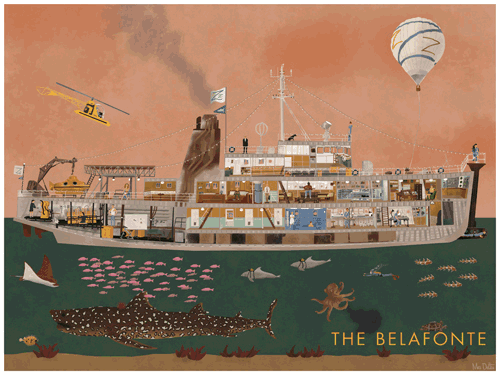
I find the comparison made between Norman Rockwell and scenes from Moonrise Kingdom interesting. Norman Rockwell illustrated many scenarios from American family life throughout the mid-20th century. He is known for his cover illustrations on The Saturday Evening Post and for Boy Scouts of American. Rockwell has made a legacy of mid-century Americana that is cheeky and nostalgic. Anderson framed many scenes as virtual parodies of Rockwell's paintings and illustrations.
This one is my favorite:

We are viewing this scene as an "other" but in the point of view of the parents. In the foreground we see the back of the parent's heads and shoulders, Mrs. Bishop on the left and Mr. Bishop on the right. In the middle ground you see the dinner table and Suzy's three younger brothers. The two brothers on the outside have their heads cocked up looking at Suzy and the one in the center is eating a piece of corn on the cob (doesn't get more American than that, unless you're talking apple pie). Standing behind the seated children is Suzy. She is the only person in the scene that has an animation to her at all. She is pointing an accusatory finger at her parents and shouting with a concerned look on her face. This moment reminds me of Norman Rockwell's paintings Election Day and Freedom From Want:
 |
 |
I think this scene says a lot about each of the characters in the film. The parents seem to be very passively listening and maybe only halfway dealing with their daughter's concerns. The three boys are somewhat perplexed and indifferent to their sister who seems to be an entirely different species from their prepubescent selves. Suzy is animated and emotional and angry and the dialogue in the scene doesn't give the viewer a reason why, much like how Suzy is unsure why she is feeling this way. The dialogue is a voice over of Suzy and Sam reading letters that they were writing back and forth to each other and Suzy is writing about how Sam should think of his parents' faces everyday (as she is yelling at her own). By referring to Rockwell's paintings, Anderson is creating a nostalgia about the passion of adolescence and the reality of family life.
Thursday, March 27, 2014
Wendy and Lucy
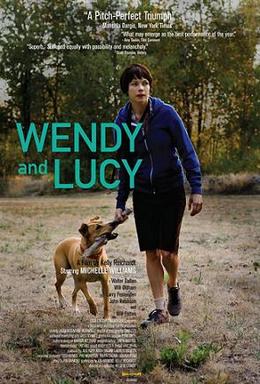
Let me start out by saying that I loved this film. It was minimal and real. There was nothing of excess in the way that the film was shot and this created and environment that allowed for a lot of contemplation about the central themes in the movie.
Most obviously, for me, this movie relates to Killer of Sheep. Although there are no issues of race that come up in Wendy and Lucy, the film is very much about gender and class. Wendy is vulnerable throughout the film in terms of safety and finances, but the economic hardship she is going through proves that she is strong. Having a strong female lead in a movie (THAT PASSED THE BECHDEL TEST) inverts the roles of women in films. This is the same role reversal as in Killer of Sheep when Stan is vulnerable and sometimes even weak. Wendy is portrayed as a human, instead of as a woman.
As much as this movie is about gender, it is even more about class. This movie was made in 2008, right as the economic crisis in America hit it's peak when the housing bubble burst. Jobs went to shit, retirement funds disappeared, and Americans were desperate. The gas and oil industry came out of the collapse even stronger than ever and with the opportunity to create new jobs where ever there was fracking to be had. Out of work Americans flocked to different states in order to find work (and eventually that's all going to shit too because fracking ruins everything) and dropped their home lives for a chance to survive. Much like immigrants from other countries, specifically Mexico, men and women left their families behind and sent money home in order to pay their mortgage or simply put food on the table. The American Dream had disappeared long before the bubble burst, but this solidified it for many working class and middle class Americans. Wendy is looking for work, for economic prosperity, and her part of the dream (also known as: surviving). By hinting that Wendy budgeted her money and kept track of her spending, the viewer can assume that she is responsible and that her financial ills are due to forces outside of her control (society, capitalism, free-market). The institutional restrains (class, gender, race) are designed to control those that are most vulnerable in society (working-class, women, non-whites) and divide them, so that they have no power to reform. The same forces that are at play in Wendy and Lucy, are also in play in Killer of Sheep.
 |
| Says society. |
Wendy and Lucy also relates to My Own Private Idaho as a road movie. In both films the characters have left their homes in search of answers. They are looking for enlightenment of some kind. They are also both from a marginalized group Wendy being a poor woman and Mike was a poor gay man. This opens up questions about how these people have fallen through the cracks of society and they have become so helpless that they have to steal and sell their bodies to make money. Why is this allowed in a society so abundant? Why are we so hesitant to help the people at the bottom of the economic ladder? Why are we so hasty to pass judgement on them? Why do we insist that hard work pays off in a country where 42.6 MILLION people are living below the poverty level?
Although these questions cannot be answered by a film, they are important to ask. It is important to realize institutional structures that limit someone's financial success and why those structures exist. This film asks those questions, as did Killer of Sheep in the 70's and My Own Private Idaho in the 90s. Being aware of these issues can help bring our country to a more conscious, compassionate, and productive world where everyone can live a healthy and safe life.

I'll step off my soapbox now.
Friday, March 14, 2014
O Brother Where Art Thou

O Brother Where Art Thou is thick on religious critique throughout the film. The main character, Everett, prides himself on his sense higher consciousness over his companions. He constantly puts himself above Pete and Delmar because they are to some extent less intelligent and he blames their "faith," intermittent as it is, on their unintelligence.
The Coens use the Odyssey as a comparison between the classical culture of "high art" and the Depression era Southern folk culture. Through the juxtaposition between villains in Greek mythology and religious figures in O Brother, they expose religion, in specific Christianity, as a corrupt institution used to benefit some and blissfully distract others.
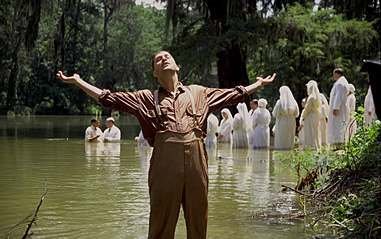
The scenes that most obviously displays this sense of blissful distraction is the baptism scene. The three men are standing around in the woods arguing about Everett stealing from Pete's family when seemingly out of no where countless people dressed in pure white robes begin to appear in the background. The camera is focused on them panning around as the turn to gaze at the people singing a hymn. Their eyes get big and they speak slower than before. The camera goes from the main characters and begins panning on the crowd and the music grows louder. Everett, Pete, and Delmar stumble bewildered into the shot and begin to follow the crowd "down to the river to pray." Delmar runs into the water to be absolved of his sins and comes out blabbering about being forgiven. Everett quickly reminds him that he is still a fugitive from the law, but Delmar is in a state of bliss because of his baptism.

The bible salesman that lures them from the restaurant to rob them is another example of the Coen brother's critique of religion. They choose to make him a man that likes to hear himself speak, who is big and intimidating, and they also allude to the Cyclops in Homer's Odyssey. Everett, up until this point in the film, hasn't allowed religion to lure him away from his logic. The salesman uses the lure of money to pull him away from his meal, showing that Everett can be distracted as easily as his companion (and frog) with objects of man's creation (religion and money).
The struggle between the logic coming from the main character and the religious undertones of the film are strong and set it up for a good critique of the institution of religion. The juxtaposition of Greek mythology and Christianity is the strongest indicator that the Coens are comparing the two and critiquing them in the same way.
Wednesday, March 5, 2014
My Own Private Idaho

My Own Private Idaho was a challenging movie for me. I don't know if I understand it. I don't feel like it was driven by plot, but instead was driven by raw human emotion. I don't feel like I needed to understand what was going on the entire time or motives behind some of the characters' actions. I understood how they felt. I felt their pain and their happiness.
There were so many breathtaking scenes in this film that were surprising (especially in the context of the other films we have watched). A few times I could feel the rug being pulled out from beneath me and my heart hurt badly for the characters, especially for Mike.
I thought that the way in which the sex scenes were shot was so interesting. Van Sant slowed down the speed of the action that we were viewing and this made me critique the act of sex in context to the film, the differences between the sex scenes, and how these changes in style changed the way that the moment felt.
The scene that rang truest for me was when Mike and Scott were sitting around the campfire talking. This scene not only made an important statement about both of the characters, but also made an important statement about the gay community in general: they are regular humans, capable of a range of emotions.
 |
| "I really want to kiss you, man." |
I have had friends confess the same things to me and for one reason or another, I did not reciprocate their feelings, but still tried to be a supportive friend. At the same time, I have been in Mike's position. It is so painful to have strong romantic feelings toward someone you love as a friend and at the same time have to worry about their reaction because it isn't something that is fully accepted. It was easier for me, being bisexual, because I had the opportunity to be in "normal" relationships as well. This scene was so incredibly real it was painful to watch. I felt for Mike and everyone that is ever in that situation and I was also angry at Scott because I saw a bit of myself in him and was ashamed.
This scene was something all together different and new from what was done in cinema regarding homosexuality. This scene made a strong statement in the realest way possible.
Friday, February 28, 2014
Spoorloos
I have seen a lot of “horror” films and I am the first to
admit that they scare the crap out of me... Some are also really bad. Those, I
think, should be technically considered comedy. Movies like Descent scare me without my eyes even being open.
When I was very young I saw almost the entire Halloween
series and I was completely convinced that it was a regular occurrence for men
in masks to chase people around with a ridiculous knife. I would have had
nightmares for days if I had done any sleeping at all.
There are so many different kinds of horror films and I am
scared by most of them. I would definitely consider The Vanishing a horror film. Raymond is made to seem like a totally
normal guy that has a family and works really hard to interact with them and
society. As the scenes go on, you begin to learn subtle things about Raymond
that makes him seem completely mentally unstable. Although he does not seem
like a supernatural creature or a monster, Raymond has the ability to disregard
societal conventions and the value of human life and commit disgusting acts.
The disparity between his public persona and his terrifying private one makes
it seem like anyone could secretly be this big of a monster.
When Raymond is telling Rex about the abduction of Saskia and they flashback to the moment when he is talking to her, I felt desperate and hopeless as she was talking to him about his keychain. I knew what was going to happen. I wanted her to turn away, I wanted him to change his mind, and I wanted to know why he was choosing to commit such a heinous act. When he chloroformed her, there was real terror in her eyes. The close up shots of the two of them put me inside of the car. I felt just as helpless as Saskia was and was terrified.
When Raymond is telling Rex about the abduction of Saskia and they flashback to the moment when he is talking to her, I felt desperate and hopeless as she was talking to him about his keychain. I knew what was going to happen. I wanted her to turn away, I wanted him to change his mind, and I wanted to know why he was choosing to commit such a heinous act. When he chloroformed her, there was real terror in her eyes. The close up shots of the two of them put me inside of the car. I felt just as helpless as Saskia was and was terrified.
The extent of obsession presented by Rex is also completely
horrifying. He is the “normal” character in the film. He represents the loving
companion that has had his love ripped tragically away from him. He is helpless
and hopeless. As the film goes on, he is compared to Raymond and his character
becomes more and more obsessed with finding out about Saskia’s disappearance.
By the end of the film he is willing to condemn himself to death in order to
learn the truth. This is pretty extreme. The way in which he dies is intense
and horrifying and imagining that the same was done to Saskia makes it even
more intense.
Raymond and Rex’s characters are so similar and this is a
factor that makes the movie horrific. Raymond is always in control, even when
Rex is beating him up. Raymond is always rational, although insane and Rex is
very irrational although his actions are always those of a sane individual. The
fear of being controlled by someone that is a sociopath is a more realistic
fear than the fear of a supernatural monster and gore.
This film was definitely highly psychological and
conceptually horrific. I’m terrified of the night I have a dream about a golden
egg.
Thursday, February 20, 2014
Killer of Sheep
This movie was difficult for me on so many levels. Wrong movie, for the wrong week.
First of all, a lifelong vegetarian with a stomach bug should never watch a movie entitled Killer of Sheep. I needed nothing more to solidify the next 20 years of vegetarianism than images of sheep heads getting split open. At least Charles Burnett didn't pull a PETA and put it in full color and high definition. Youch.
This movie was pretty mundane. There was a sense of hopelessness, like nothing was going to change. There was a strong sense of longing from all the characters- the wife and mother longs for the attention of her husband who longs for the opportunity for a big break, the boy who longs for the respect and power that comes with being a man, and the girl who longs for the attention of her father. The entire time I was simply waiting for something to break the constrains of tightly shot frames.
In the end, nothing really happened. They got a flat tire. It rained. They smiled. He worked.

This film was difficult because Hollywood has trained me to expect certain things from films. They are meant to be narratives in the sense that they have a beginning, a middle, and an ending. The quality of the film is judged by the length of the three and the strength of the climax.
This film was difficult because I have been trained to think certain things about films about family life. There is always some seemingly insurmountable question that either tears the traditional confines of family apart or makes them even stronger.
This film was difficult because I have been trained to see black people in very few roles (black actors make up roughly 15% of the actors in film and TV) especially in all the leading roles of a film. This film is older than the statistic, but this film is different than even the most progressive stories told today.
The reason I truly struggled with this film so much wasn't because the story was mundane and it definitely wasn't because the cinematography or the characters (both were stellar, RIP sheep). Killer of Sheep showed me a little too much real. It made me uncomfortable. I cringed at the idea that this was made almost 40 years ago. This film didn't have a happy ending. This isn't some fuddy-duddy Love & Basketball movie were everyone is successful and falls in love and blah blah blah. There is no happy ending to the conversation this film has started yet either.
This family hurts sometimes. It is stressed and tired and hopeless, but there are small moments when that can be forgotten before the next day at work starts. The entire film was really dragging on for me until the scene at the very end when Stan is at work. I have felt that almost every working moment of my life. Coming home to a messy apartment and a screaming child that wants food and juice and the cat dug up a plant and the puppy pissed on the floor and I have to make dinner and wash my work clothes, but then there's the perfect moment when I get a child's kiss on the nose when everything is silent. It could be raining. I could have a flat. It doesn't matter because the next day I have to go back to work. Whomp, whomp. That's the true story of a working class family life.
One of the most surface things that we forget about film is that there is no path that it needs to be on. It is not art just because it is in the "proper" or expected order. This film is as solid as the most narrative Caravaggio painting, the most mundane Toulouse Lautrec drawing, or the most vivid Dutch still life. To tell a story you only need a single moment and everything else can be filled in based off the historical context. Killer of Sheep gave us a moment in the lives of a family and everything else is for us to figure out. Compelling? Totally.
This movie was difficult to watch, but it was good. There was no glorified Hollywood drama about what its like to be a black man or a family man. There's no Foxy Brown there to save the day. Thankfully this was a dose of real life perspective that can keep an inch of our reality in check mode.

 |
| LOVE ME. |
First of all, a lifelong vegetarian with a stomach bug should never watch a movie entitled Killer of Sheep. I needed nothing more to solidify the next 20 years of vegetarianism than images of sheep heads getting split open. At least Charles Burnett didn't pull a PETA and put it in full color and high definition. Youch.
This movie was pretty mundane. There was a sense of hopelessness, like nothing was going to change. There was a strong sense of longing from all the characters- the wife and mother longs for the attention of her husband who longs for the opportunity for a big break, the boy who longs for the respect and power that comes with being a man, and the girl who longs for the attention of her father. The entire time I was simply waiting for something to break the constrains of tightly shot frames.
In the end, nothing really happened. They got a flat tire. It rained. They smiled. He worked.
This film was difficult because Hollywood has trained me to expect certain things from films. They are meant to be narratives in the sense that they have a beginning, a middle, and an ending. The quality of the film is judged by the length of the three and the strength of the climax.
This film was difficult because I have been trained to think certain things about films about family life. There is always some seemingly insurmountable question that either tears the traditional confines of family apart or makes them even stronger.
This film was difficult because I have been trained to see black people in very few roles (black actors make up roughly 15% of the actors in film and TV) especially in all the leading roles of a film. This film is older than the statistic, but this film is different than even the most progressive stories told today.
The reason I truly struggled with this film so much wasn't because the story was mundane and it definitely wasn't because the cinematography or the characters (both were stellar, RIP sheep). Killer of Sheep showed me a little too much real. It made me uncomfortable. I cringed at the idea that this was made almost 40 years ago. This film didn't have a happy ending. This isn't some fuddy-duddy Love & Basketball movie were everyone is successful and falls in love and blah blah blah. There is no happy ending to the conversation this film has started yet either.
This family hurts sometimes. It is stressed and tired and hopeless, but there are small moments when that can be forgotten before the next day at work starts. The entire film was really dragging on for me until the scene at the very end when Stan is at work. I have felt that almost every working moment of my life. Coming home to a messy apartment and a screaming child that wants food and juice and the cat dug up a plant and the puppy pissed on the floor and I have to make dinner and wash my work clothes, but then there's the perfect moment when I get a child's kiss on the nose when everything is silent. It could be raining. I could have a flat. It doesn't matter because the next day I have to go back to work. Whomp, whomp. That's the true story of a working class family life.
One of the most surface things that we forget about film is that there is no path that it needs to be on. It is not art just because it is in the "proper" or expected order. This film is as solid as the most narrative Caravaggio painting, the most mundane Toulouse Lautrec drawing, or the most vivid Dutch still life. To tell a story you only need a single moment and everything else can be filled in based off the historical context. Killer of Sheep gave us a moment in the lives of a family and everything else is for us to figure out. Compelling? Totally.
This movie was difficult to watch, but it was good. There was no glorified Hollywood drama about what its like to be a black man or a family man. There's no Foxy Brown there to save the day. Thankfully this was a dose of real life perspective that can keep an inch of our reality in check mode.
Friday, February 14, 2014
The Good, The Bad, and The Ugly
 |
Needless to say, Clint Eastwood haunted my dreams, until I was at least twelve. He is portrayed as being somehow superior. He is above the law. He is stronger than his adversaries. He is fearless and seems virtually immortal. Clint Eastwood's characters have embodied the ultimate man.
 |
| Eastwood in The Outlaw Josey Wales = TOO MUCH MAN |
As the Man with No Name (Blondie), he is emotionless, even in times of great struggle (trudging through the desert without water for miles) and gives no signs of emotional weakness even when his mortal body is failing him. He always finds his way out of tough moments with the most flawless reactions (mostly bad-ass one liners) as if he had been planning his escape the entire time.
Clint Eastwood's characters are the man of all men. They are frequently mean for the sake of being mean, superior to those around them and constantly prove this through their silent and competitive (survival of the fittest) nature. He doesn't need to entertain other's feelings or circumstance and doesn't think twice about the law in regards to himself. He is the aura of all bad-assery that has a tiny soft side somewhere in his heart.
There is very little variation between the Clint Eastwood brand and Clint Eastwood the person as evident by his lifetime achievements of multiple baby mamas, a collection of Academy Awards, a mean golf swing, and an always furrowed brow. His politics leave little room for compassion and he has no time for useless women in his life (he goes through them like crappy Dunkin' Donut's napkins). It's unclear whether his personality informed his career decisions or whether the myth of Clint Eastwood was even too much for his mortal self to bear.
Thursday, February 6, 2014
Her
POSSIBLE SPOILER ALERT?
Last Saturday, Elizabeth and I went and saw Her at the Esquire. See. Look at us.

Last Saturday, Elizabeth and I went and saw Her at the Esquire. See. Look at us.
 |
| We are best friends. |
This was a totally pre-planned Saturday night activity, and we just so happen to be lucky enough to get extra credit. Sweet.
So, first of all, I feel I should get all of my emotions about Spike Jonze out of the way. SO MANY FEEL GOODS.
Also, I need to get my emotions out of the way for Scarlett Johansson. DYING EVERYWHERE WITH FEEL GOODS.
Then there's Rooney Mara, Rooney Mara, Rooney Mara, Rooney Mara.
And, last (and least), I also have lots of feel goods for Joaquin Phoenix (that 'stache, though/ those pants, though).
Her was so good. I enjoyed every part of it. The awkward pants and cat porn, the overly saturated urbanscapes, the empty bookshelves, the tea bag. Spike Jonze is seriously my hero.
I came out of the theatre with my mind tangled up like limp spaghetti and I still don't even know where to begin other than I am never seeing another Jonze movie in theatres ever again. I needed to be in the comfort of my own messy apartment to fully absorb everything. I want to watch it again and again.
The irony between how real the relationship between Theodore and Samantha, his operating system, was unbearable and so uncanny in regards to the relationships we have online, both with each other and with ourselves. This movie was able to take a critical look at the nature of our relationships. By comparing Theodore's failed relationship with his human companion and his relationship with his OS, Jonze was able to allow us to understand the importance of human interaction and question the role that technology plays in our own relationships (this was also pointed out with Theodore's job of writing "Hand Written Letters"). The ridiculousness of the "dates" that Theodore and Samantha went on were emphasized by the overly exposed days and the flashy lights of the night, while the flashbacks of moments between Theodore and his ex-wife seemed so real. You could feel the tension between them.
The scene where Theodore and Catherine were having an argument (about money, maybe? I am too enthralled with the visuals of the scene to remember the relevance of the fight) seemed so incredibly familiar. Everything about the scene could have been a moment from anyone's past. Theodore wore stark white boxer shorts that were cocked a bit to the side and Catherine drank hot tea from a ceramic glass and the tea bag hung loosely over the edge of the cup. The tension in the room was so strong and the situation so perfectly realistic.
The film also raises strong questions about our ability to perceive information, our rate of perception, and the value we place on that information, or, rather, knowledge. By enabling us to feel inferior in capacity to the OS and their ability to access information within milliseconds, Jonze makes us question our intelligence as a species and the roles that our technology plays as an aid or a hindrance on our quest to become better at literally everything.
Something in the movie that made me particularly anxious was Theodore's apartment. There was so much emphasis put on his devices (computer, video game, cell phone) and outside of his virtual reality his life was completely bare. I understand that the scarcity was meant to aid in the development of his character, to show that he was just barely existing as a human being and functioning with the least amount of social interaction. I found it incredibly disturbing that he had an entire wall of bookshelves, but not one book. I don't think that it is old fashioned to believe in the power of a good book, nor is it old fashioned to rely on the knowledge of print. I think that Jonze was showing how little the future masses will rely on the archive of knowledge that we can access through physical existence. Books will become clutter because all the knowledge we need can be found through our OS. The reason I found this disturbing, was because in the end of the film (WARNING MINOR SPOILER ALERT), the OS's became unreliable. We (future us) put all our eggs in one basket. We occupied our minds with too many unreasonable and unnecessary things (video games) and relied on some unseen power for real knowledge. Our ability to archive thoughts, memories, ideas, knowledge is decreasing with the increased use of technology as a crutch.
I can't go on anymore, I'm starting to get frustrated with how much we suck at life.
Her was amazing. Go see it. THE END.
Awara
 |
| http://www.covershut.com/cover-tags/Awaara-1951.html |
Bollywood cinema is not completely new to me. I have been exposed to some of the culture surrounding Bollywood, specifically the musical aspect of it from a childhood friend. I wasn't at all surprised when there was randomly a hundred women dancing strangely through the hills.
 |
| http://www.popscreen.com/v/6TAHw/Ghar-aaya-mera-pardesi-Awara1951 |
Whether or not Awara is a musical is questionable. I suppose it depends on by whose terms we are asking. American cinema very rarely has choreographed musical numbers unless it is a musical. You wouldn't just see people break out into elaborate synchronized dance moves in The Notebook (that's pretty melodramatic right?), but you would in Grease, and the songs would further the plot or character development.
 |
| http://www.youtube.com/watch?v=P6z-bmG6YeE |
 |
| http://staticmass.net/world/awara-1951-movie-review/ |
p.s.
SO MANY ANGRIES IN THIS SCENE! AH!
p.p.s.
Caps lock means I yelled that and, also, probably yelled at the movie.
Thursday, January 30, 2014
Detour
There is a little thing called the Bechdel Test. Some of you may have heard of it. But for the sake of those who are unaware of this "feminist" phenomenon, I will break it down.
To pass the Bechdel Test a movie must:
1) have at least two named women in it.
2) who talk to each other
3) about something other than a man.
Pretty simple, right?
It is surprising how many films DO NOT pass this test. None of the films we have watched so far in the semester have passed this test. No surprise there. The Bechdel Test does not show whether or not the movie is good (there are plenty of Lifetime Network movies that pass the test that are TERRIBLE), although this test gives a good starting point for the role of women in the film.
There are two women in Detour that are named (Sue and Vera). These women are used as important plot devices in the film. Sue- the goal and Vera- the challenge. The fact that Al has ditched the body of a dead man, robbed him of his wallet and car, and taken on his identity becomes a side note to the femme fatale. Vera becomes the horrible person standing in the way of Al and his love. She is attractive and mysterious and all together bat shit crazy. Although, it is interesting that she is not a murderer. Just sayin'.
Aside from morals (film noir does a good job of taking care of those), Vera is an under-developed character when compared to Al, which is surprising due to the importance she plays in the film. Sue is also incredibly undeveloped as well. She is the beautiful blonde with the commendable ambition of becoming a wonderful actress in Hollywood who ends up working hard to pursue her dreams in a tough town, but stays faithful to her beau all the way across the country through telephone conversations and swoons at the idea of him traveling across the country for her. Awww. Not. There is a moment in the beginning of the movie during the scene where Al and Sue are leaving the Break O' Dawn Club that almost tags Sue as a real character. Sue begins explaining to Al that she is going to L.A. but it turns into her being sappy about how she will miss him so much but that they'll always be together. Also, he flat says she has no sense and she's totally cool with that. Pause. Women (as I'm sure we all know) are capable of emotions... But "its cool, call me senseless." What woman would ever react like that? Come on... Am I right?
Can't a girl have dreams?
In Detour women are confined to certain archetypes or menial workers that are the butt of men's sexual jokes (Hey sister, meet me outside after your shift... insert winky face here).
But hey, it was the 40's...
To pass the Bechdel Test a movie must:
1) have at least two named women in it.
2) who talk to each other
3) about something other than a man.
Pretty simple, right?
It is surprising how many films DO NOT pass this test. None of the films we have watched so far in the semester have passed this test. No surprise there. The Bechdel Test does not show whether or not the movie is good (there are plenty of Lifetime Network movies that pass the test that are TERRIBLE), although this test gives a good starting point for the role of women in the film.
There are two women in Detour that are named (Sue and Vera). These women are used as important plot devices in the film. Sue- the goal and Vera- the challenge. The fact that Al has ditched the body of a dead man, robbed him of his wallet and car, and taken on his identity becomes a side note to the femme fatale. Vera becomes the horrible person standing in the way of Al and his love. She is attractive and mysterious and all together bat shit crazy. Although, it is interesting that she is not a murderer. Just sayin'.
Aside from morals (film noir does a good job of taking care of those), Vera is an under-developed character when compared to Al, which is surprising due to the importance she plays in the film. Sue is also incredibly undeveloped as well. She is the beautiful blonde with the commendable ambition of becoming a wonderful actress in Hollywood who ends up working hard to pursue her dreams in a tough town, but stays faithful to her beau all the way across the country through telephone conversations and swoons at the idea of him traveling across the country for her. Awww. Not. There is a moment in the beginning of the movie during the scene where Al and Sue are leaving the Break O' Dawn Club that almost tags Sue as a real character. Sue begins explaining to Al that she is going to L.A. but it turns into her being sappy about how she will miss him so much but that they'll always be together. Also, he flat says she has no sense and she's totally cool with that. Pause. Women (as I'm sure we all know) are capable of emotions... But "its cool, call me senseless." What woman would ever react like that? Come on... Am I right?
Can't a girl have dreams?
In Detour women are confined to certain archetypes or menial workers that are the butt of men's sexual jokes (Hey sister, meet me outside after your shift... insert winky face here).
But hey, it was the 40's...
Wednesday, January 22, 2014
Freaks
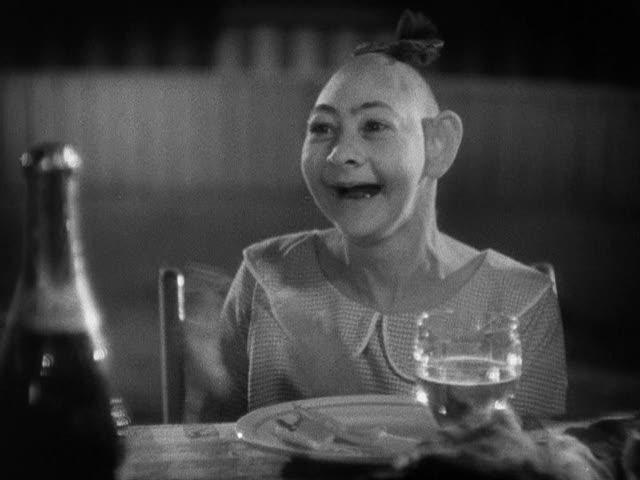
Freaks (1934) was a controversial film that gained a cult following some years after it was originally released. There is an obvious fascination in this film with a counter culture of people that are different than you and I, and this fascination is something that is still in our contemporary culture as evidenced by shows like My Strange Addiction and films like Safety Not Guaranteed. To some extent, viewers' curiosity hinges on their disgust and their pity for those they see to be less fortunate than themselves. I think this movie could be both an advocate for equality and a cruel example of the differences between us. History has shown a severe intolerance for diversity and tends to lack compassion, though the "freaks" in this film were not shown as less fortunate or incompetent in any way. On the contrary there are many moments when the freaks are given more power and commendable qualities than the beautiful trapeze artist. From the beginning Hans is a character that is all too familiar in stories; the man that superficially falls in love with the bombshell gold digger. This is a relatable human emotion (love, vulnerability, recklessness) that was given to the "dwarf" instead of the "brute" in the story. There is also a genuine friendship between Venus and Frieda despite their differences. There is a moment where the two characters are chatting about Frieda's relationship with Hans, a completely normal conversation that has taken place in almost every single film ever made that can't pass the Bechdel Test (most movies). This sense of normalcy flows throughout the film. Although, there are moments that are quite concerning when it comes to the topic of equality by a contemporary critic, I think the film airs mostly on the tolerant side of the conversation.


Wednesday, January 15, 2014
Sherlock Jr.
I have found myself pleasantly surprised in this week’s film
selection of Sherlock Jr. (1924). I knew in signing up for this class that we
would undoubtedly be assigned a silent movie.
Between clocking out, momentary studio work time, and a speedy bike ride
to the daycare center I was able to settle down onto the smelly futon in the
Sculpture Department with Lizz to watch 45 minutes of ridiculousness.
We both groaned a bit when the first bit of
text popped up on the screen, but I was soon surprised to be laughing at Buster
Keaton’s silly antics. His situations
were both relatable and relevant, from trying to sneak some personal reading
time into your work day, to sweeping up garbage, to feeling inadequate, unsure,
or awkward around his crush. These are all
situations that, nine decades later, I can still personally embody and
experience on a daily basis.


Throughout
the film we joked about his intense makeup, glorious stunts, and unfortunate
luck. I was able to draw comparisons to
the short series created by David Cross The
Increasingly Poor Decisions of Todd Margaret (2009). Vulgarities aside, Todd Margaret and Sherlock
Jr. both have the leading man (David Cross and Buster Keaton, respectively)
vying for the attentions of the leading lady (Sharon Horgan and Kathryn
McGuire). In both comedies, Cross and
Keaton’s characters are trying to be something they are not. Cross is masquerading as a successful
salesman and Keaton as a detective. The villains
in both cases are also “sheiks” (Blake Harrison and Ward Crane).

.jpg)
There
are a surprising amount of parallels between the comedy in 1924 and
contemporary comedies. The smallest misstep
or misfortune draws the biggest laugh, which underlines the idea that we find
humanity hilarious. Also, fake mustache.
Subscribe to:
Posts (Atom)