Thursday, March 27, 2014

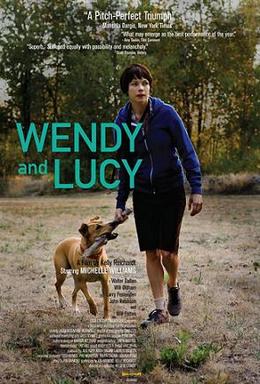
Wendy and Lucy


Let me start out by saying that I loved this film. It was minimal and real. There was nothing of excess in the way that the film was shot and this created and environment that allowed for a lot of contemplation about the central themes in the movie. 

Most obviously, for me, this movie relates to Killer of Sheep. Although there are no issues of race that come up in Wendy and Lucy, the film is very much about gender and class. Wendy is vulnerable throughout the film in terms of safety and finances, but the economic hardship she is going through proves that she is strong. Having a strong female lead in a movie (THAT PASSED THE BECHDEL TEST) inverts the roles of women in films. This is the same role reversal as in Killer of Sheep when Stan is vulnerable and sometimes even weak. Wendy is portrayed as a human, instead of as a woman. 

As much as this movie is about gender, it is even more about class. This movie was made in 2008, right as the economic crisis in America hit it's peak when the housing bubble burst. Jobs went to shit, retirement funds disappeared, and Americans were desperate. The gas and oil industry came out of the collapse even stronger than ever and with the opportunity to create new jobs where ever there was fracking to be had. Out of work Americans flocked to different states in order to find work (and eventually that's all going to shit too because fracking ruins everything) and dropped their home lives for a chance to survive. Much like immigrants from other countries, specifically Mexico, men and women left their families behind and sent money home in order to pay their mortgage or simply put food on the table. The American Dream had disappeared long before the bubble burst, but this solidified it for many working class and middle class Americans. Wendy is looking for work, for economic prosperity, and her part of the dream (also known as: surviving). By hinting that Wendy budgeted her money and kept track of her spending, the viewer can assume that she is responsible and that her financial ills are due to forces outside of her control (society, capitalism, free-market). The institutional restrains (class, gender, race) are designed to control those that are most vulnerable in society (working-class, women, non-whites) and divide them, so that they have no power to reform. The same forces that are at play in Wendy and Lucy, are also in play in Killer of Sheep. 

Says society.


Wendy and Lucy also relates to My Own Private Idaho as a road movie. In both films the characters have left their homes in search of answers. They are looking for enlightenment of some kind. They are also both from a marginalized group Wendy being a poor woman and Mike was a poor gay man. This opens up questions about how these people have fallen through the cracks of society and they have become so helpless that they have to steal and sell their bodies to make money. Why is this allowed in a society so abundant? Why are we so hesitant to help the people at the bottom of the economic ladder? Why are we so hasty to pass judgement on them? Why do we insist that hard work pays off in a country where 42.6 MILLION people are living below the poverty level? 

Although these questions cannot be answered by a film, they are important to ask.  It is important to realize institutional structures that limit someone's financial success and why those structures exist. This film asks those questions, as did Killer of Sheep in the 70's and My Own Private Idaho in the 90s. Being aware of these issues can help bring our country to a more conscious, compassionate, and productive world where everyone can live a healthy and safe life. 


I'll step off my soapbox now. 

Friday, March 14, 2014

O Brother Where Art Thou


O Brother Where Art Thou is thick on religious critique throughout the film. The main character, Everett, prides himself on his sense higher consciousness over his companions. He constantly puts himself above Pete and Delmar because they are to some extent less intelligent and he blames their "faith," intermittent as it is, on their unintelligence.  

The Coens use the Odyssey as a comparison between the classical culture of "high art" and the Depression era Southern folk culture. Through the juxtaposition between villains in Greek mythology and religious figures in O Brother, they expose religion, in specific Christianity, as a corrupt institution used to benefit some and blissfully distract others.


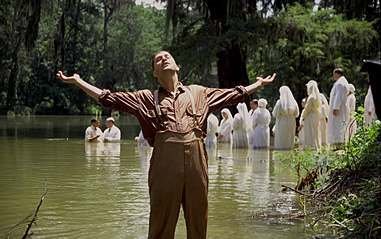
The scenes that most obviously displays this sense of blissful distraction is the baptism scene. The three men are standing around in the woods arguing about Everett stealing from Pete's family when seemingly out of no where countless people dressed in pure white robes begin to appear in the background. The camera is focused on them panning around as the turn to gaze at the people singing a hymn. Their eyes get big and they speak slower than before. The camera goes from the main characters and begins panning on the crowd and the music grows louder. Everett, Pete, and Delmar stumble bewildered into the shot and begin to follow the crowd "down to the river to pray." Delmar runs into the water to be absolved of his sins and comes out blabbering about being forgiven. Everett quickly reminds him that he is still a fugitive from the law, but Delmar is in a state of bliss because of his baptism.


The bible salesman that lures them from the restaurant to rob them is another example of the Coen brother's critique of religion. They choose to make him a man that likes to hear himself speak, who is big and intimidating, and they also allude to the Cyclops in Homer's Odyssey. Everett, up until this point in the film, hasn't allowed religion to lure him away from his logic. The salesman uses the lure of money to pull him away from his meal, showing that Everett can be distracted as easily as his companion (and frog) with objects of man's creation (religion and money).

The struggle between the logic coming from the main character and the religious undertones of the film are strong and set it up for a good critique of the institution of religion. The juxtaposition of Greek mythology and Christianity is the strongest indicator that the Coens are comparing the two and critiquing them in the same way.

Wednesday, March 5, 2014

My Own Private Idaho


My Own Private Idaho was a challenging movie for me. I don't know if I understand it. I don't feel like it was driven by plot, but instead was driven by raw human emotion. I don't feel like I needed to understand what was going on the entire time or motives behind some of the characters' actions. I understood how they felt. I felt their pain and their happiness.

There were so many breathtaking scenes in this film that were surprising (especially in the context of the other films we have watched). A few times I could feel the rug being pulled out from beneath me and my heart hurt badly for the characters, especially for Mike.

I thought that the way in which the sex scenes were shot was so interesting. Van Sant slowed down the speed of the action that we were viewing and this made me critique the act of sex in context to the film, the differences between the sex scenes, and how these changes in style changed the way that the moment felt.

The scene that rang truest for me was when Mike and Scott were sitting around the campfire talking. This scene not only made an important statement about both of the characters, but also made an important statement about the gay community in general: they are regular humans, capable of a range of emotions.

"I really want to kiss you, man."
It was easy for me to relate to both of the characters in this situation, as I have been in both of their shoes (only I'm a girl and not a prostitute). Mike longed to tell Scott his feelings and Scott, to some extent, was embarrassed by this and by his own feelings that he repressed. Scott always made excuses for his homosexuality and pretended to be gay only for the pay and that once he had inherited money he would change his lifestyle. Mike struggled with memories from his past and narcolepsy and Scott was always there for him as a friend to help him. When Mike decided to confess his romantic emotions to Scott he was shut down with open arms by a man that loved him but was too embarrassed or pressured to truly admit to being gay.

I have had friends confess the same things to me and for one reason or another, I did not reciprocate their feelings, but still tried to be a supportive friend. At the same time, I have been in Mike's position. It is so painful to have strong romantic feelings toward someone you love as a friend and at the same time have to worry about their reaction because it isn't something that is fully accepted. It was easier for me, being bisexual, because I had the opportunity to be in "normal" relationships as well. This scene was so incredibly real it was painful to watch. I felt for Mike and everyone that is ever in that situation and I was also angry at Scott because I saw a bit of myself in him and was ashamed.

This scene was something all together different and new from what was done in cinema regarding homosexuality. This scene made a strong statement in the realest way possible.