
O Brother Where Art Thou is thick on religious critique throughout the film. The main character, Everett, prides himself on his sense higher consciousness over his companions. He constantly puts himself above Pete and Delmar because they are to some extent less intelligent and he blames their "faith," intermittent as it is, on their unintelligence.
The Coens use the Odyssey as a comparison between the classical culture of "high art" and the Depression era Southern folk culture. Through the juxtaposition between villains in Greek mythology and religious figures in O Brother, they expose religion, in specific Christianity, as a corrupt institution used to benefit some and blissfully distract others.
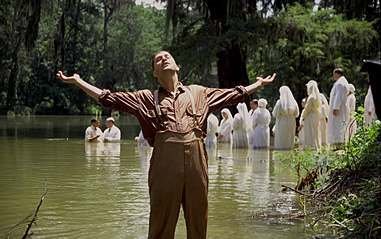
The scenes that most obviously displays this sense of blissful distraction is the baptism scene. The three men are standing around in the woods arguing about Everett stealing from Pete's family when seemingly out of no where countless people dressed in pure white robes begin to appear in the background. The camera is focused on them panning around as the turn to gaze at the people singing a hymn. Their eyes get big and they speak slower than before. The camera goes from the main characters and begins panning on the crowd and the music grows louder. Everett, Pete, and Delmar stumble bewildered into the shot and begin to follow the crowd "down to the river to pray." Delmar runs into the water to be absolved of his sins and comes out blabbering about being forgiven. Everett quickly reminds him that he is still a fugitive from the law, but Delmar is in a state of bliss because of his baptism.

The bible salesman that lures them from the restaurant to rob them is another example of the Coen brother's critique of religion. They choose to make him a man that likes to hear himself speak, who is big and intimidating, and they also allude to the Cyclops in Homer's Odyssey. Everett, up until this point in the film, hasn't allowed religion to lure him away from his logic. The salesman uses the lure of money to pull him away from his meal, showing that Everett can be distracted as easily as his companion (and frog) with objects of man's creation (religion and money).
The struggle between the logic coming from the main character and the religious undertones of the film are strong and set it up for a good critique of the institution of religion. The juxtaposition of Greek mythology and Christianity is the strongest indicator that the Coens are comparing the two and critiquing them in the same way.

No comments:
Post a Comment